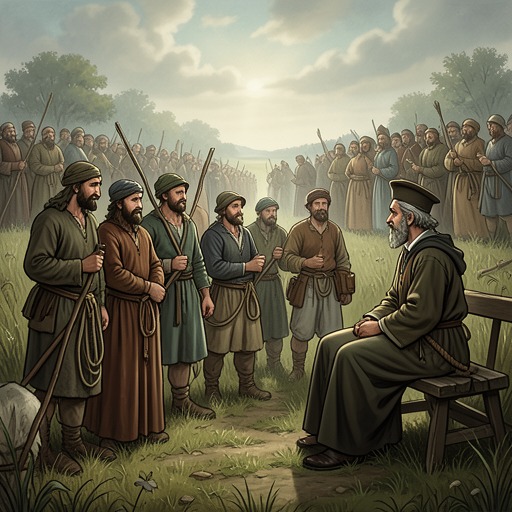
Boryna loses the lawsuit against the manor
The PeasantsMaciej Boryna loses his lawsuit against the manor despite the Voyt’s assurances, and the defeat costs him more than the case: he must also pay the legal costs. His return through a blizzard turns the judgment into a revealing encounter with Hanka Borynowa. Against the storm and the household’s hardship, Boryna speaks not of surrender but of recovering his losses, framing patience as a means of shaping fate.
The defeat and its cost
Boryna’s loss is stated plainly during his return from court: he has lost the lawsuit against the manor and must pay the costs as well. The reference to the Voyt’s assurances makes the outcome a disappointment beyond the courtroom. Whatever confidence those assurances had offered, they did not protect Boryna from the judgment or its financial consequence. The loss is therefore both a legal setback and a direct material burden.
The evidence does not elaborate the court’s reasoning or the specific terms of the suit. What matters in this episode is the result and Boryna’s response to it. He does not treat the judgment as the final word. His calm declaration, “I’ll get back what I lost, I will that …”, turns defeat into a promise of future recovery, although he gives no immediate plan for how he will accomplish it.
The return through the blizzard
The journey home places the news within the struggle of ordinary winter life. Boryna is returning from court with Witek and Ambrozy as a blizzard makes the road difficult to travel. The sled moves slowly through deep drifts; in the worst places, the men must lead the horses by their bridles. Their loud joking and Ambrozy’s humming contrast with the physical difficulty of getting through the snow.
Hanka Borynowa is making her way along the forest’s edge, carrying wood in a basket, when she hears the approaching sled. She recognizes the white patch on the filly’s forehead and steps aside, drawing her shawl over her face. Boryna nevertheless recognizes her as they pass and first drives the horses on. He then turns back, stops the sled, and offers her a lift, telling her to put the wood in the basket and get in. When she leaves the sled at the path to the cottage, he helps put the load on her back. The brief exchange brings the court loss into contact with the household’s immediate winter labor: legal costs fall on a family whose members are already working to secure fuel and get home through the storm.
Patience as a response
Boryna discusses the case with Ambrozy on the road. Ambrozy warns that the manor has “long arms” and can win favour in many places. His remark makes the defeat appear connected not only to the legal decision but also to the manor’s reach and influence. Boryna does not answer by denying that advantage. Instead, he says there is a way to deal with favour, as there is a way to deal with everything, provided one has patience and waits for the right moment.
The exchange establishes a contrast between the two men’s assessments. Ambrozy emphasizes the strength the manor can command; Boryna answers by emphasizing time, judgment, and persistence. He later extends that idea through the image of a blacksmith: “only a blacksmith need strike while the iron’s hot.” For someone seeking to win, he says, fate must be forged cold and tempered with patience. The image converts a financial and legal loss into a problem of timing. His confidence is not evidence that the case can be reversed, but it shows that he refuses to let the judgment dictate the limit of his ambition.
Significance of the episode
The lawsuit’s defeat gives Boryna’s resolve a concrete obstacle: the manor has prevailed, and he has been made responsible for the costs. Yet the episode avoids a simple picture of either collapse or triumph. Boryna’s stated determination is set beside the hard facts of the journey—horses struggling through drifts, a blizzard obscuring the houses, and Hanka carrying firewood. The contrast makes his language of patience sound both assertive and grounded in a world where gains are difficult to secure.
The scene also shows how the manor’s power is discussed in the village: not as an abstract institution, but as an adversary whose influence, in Ambrozy’s view, can reach wherever favour is decided. Boryna’s answer does not erase that imbalance. It gives his response its character: he accepts that the present moment has gone against him, but imagines another moment in which he can act. The case ends in defeat; his account of what comes next remains one of waiting, endurance, and an effort to recover what he has lost.